What are the specific risks and opportunities AI introduces for digital citizenship within Canadian education? What role does media literacy education play in empowering learners to critically assess AI-generated content, misinformation, and extremist narratives online?
Because AI is a technology, it fits into necessary media literacy skills for students. The risk of encountering AI for young kids is that they may not know what is true and what is false, which may lead them to be misinformed. The presence of AI is only going to grow, so I think it will be very important to teach young students how to critically assess media that they encounter. If kids can interact responsibly with AI, they can use it more effectively and can recognize when it’s useful.
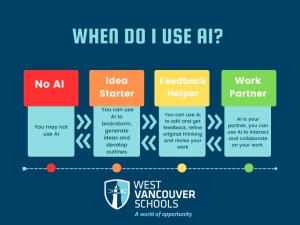
A tool, or guideline, that I have looked at in the past from School District 45 is the zones of AI use. This is a guideline that they have introduced for teachers to use with their students. It sets out four zones for AI use for schoolwork. This is a great tool for implementing the use of AI in the classroom, but also for teaching kids how to think critically about AI. I think that, particularly, the orange and yellow zones allow for good thinking about AI. When using it as an Idea starter or a feedback helper, students can create their own work and think about how the AI output could be helpful or unhelpful.
Describe an example of AI-amplified misinformation observed on Canadian social media, explain its potential impact on public opinion, and link your reflection to one of the resources above. Propose and justify a media literacy curriculum segment that teaches learners/employees to assess AI-driven social media content critically.
One example that I encountered was of AI-generated images of wildfires here in B.C. (Kulkarni, 2025). These AI-generated images have been shared on social media, which can create a dangerous situation if someone doesn’t know they are false images. One risk shared in the news release on CBC was that if there is an actual fire going on and a person only sees an AI-generated image of it, the flames could look a lot smaller than they actually are, which would make it look less serious. That person could perceive the fire as a non-threat when in reality they could be in danger. Another risk that I thought of is that if someone sees an AI-generated image of a fire when there isn’t one, they may be at risk if they try to evacuate the area unsafely. In general, I think AI-generated misinformation can lead to the over- or underestimation of safety issues. Now that social media is more widely used, authorities like a local fire department may use it to spread notices more widely. AI-generated misinformation can lessen the public’s trust in these authorities with important information to share.
The new AI for All release gives me some hope that in the future we can have better training about AI, how to use it, and reflect critically on it. The release proposes that AI is a growing sector and that Canadians need to learn to use it to develop digital citizenship, all while inviting economic growth and creating new jobs for Canadians (Government of Canada, 2026). What interests me the most is the resources that will be available for the classroom. The release mentions a new National AI Literacy Initiative that will “train more than 3,000 educators with AI learning kits in their classrooms”. I am very curious to see what that will look like and what the AI learning kits will be composed of. Hopefully, this will support learning in the classroom about how to be critical of AI and how to recognize AI misinformation.
The curriculum segment that I would propose is an age-appropriate lesson on what misinformation can look like on social platforms that students may be using. This would depend on the age of the students. For example, for a younger age, they could be shown examples from YouTube and other websites they may encounter online. The examples would then be followed by a discussion about why misinformation can be dangerous. The session could end with exploring social platforms to look for misinformation and some suggestions of tips for how to critically reflect on AI-generated content. This activity/session is justified by the B.C. Curriculum, which calls for critical and reflective thinking for every grade as part of the Core Competency of Thinking. More specifically, the facets of Analyzing and Critiquing, Questioning and Investigating, and Reflecting and Assessing (British Columbia Ministry of Education, 2026). These facets call for students to gather evidence, make judgements about works, positions, and processes, and reflect on and assess their learning. This competency applies to all grades, K-12, and onwards. Questioning and assessing different forms of media is an important part of media literacy and will continue to be as the presence of AI grows.
Is personal data being collected without an explicit educational purpose? Are third-party analytics compliant with Canadian privacy standards? Do students have meaningful control over their own information?
Before beginning to answer this question, I wanted to familiarize myself with what PIPEDA actually is: it is a document that outlines how private sector organizations can collect and use information, mainly related to commercial activity (Office of the Privacy Commissioner of Canada, 2024). My understanding is that schools and private sector organizations in provinces with similar legislation to PIPEDA do not fall under PIPEDA (Office of the Privacy Commissioner of Canada, 2015). That being said, there are still privacy guidelines in place to protect the rights of students. In BC, there is a Personal Information Protection Act that regulates the collection and disclosure of information by private education authorities and a Freedom of Information and Protection of Privacy Act that does the same for public bodies (Government of British Columbia, 2025). Therefore, although schools do not fall under PIPEDA, the privacy rights of students are still protected. PIPEDA limits data collection, but it is allowed under the condition that the collection is lawful, consensual, and accurate (Office of the Privacy Commissioner of Canada, 2025). The organization must also disclose the reason for collecting data before or at the time of collection. So, your personal data may be collected but in order for it to be legal it must still comply with PIPEDA’s fair information principles.
— Sofia
British Columbia Ministry of Education. (2026). Critical Thinking and Reflective Thinking. BC’s Curriculum. https://curriculum.gov.bc.ca/competencies/thinking/critical-and-reflective-thinking
Government of British Coumbia. (2025). Personal information protection act. Gov.bc.ca. https://www2.gov.bc.ca/gov/content/education-training/k-12/administration/program-management/independent-schools/other-legislation-regulations/personal-information-protection-act
Government of Canada. (2026, June 4). Prime minister carney launches AI for all: Canada’s new national artificial intelligence strategy. Prime Minister of Canada. https://www.pm.gc.ca/en/news/news-releases/2026/06/04/prime-minister-carney-launches-ai-all-canadas-new-national-artificial
Kennedy, C. (2024, October 2). The Stages of GenAI Adoption in Schools. The Culture of Yes. https://cultureofyes.ca/2024/10/02/the-stages-of-genai-adoption-in-schools/
Kulkarni, A. (2025, August 6). AI-generated wildfire images spreading misinformation in B.C., fire officials warn. CBC News. https://www.cbc.ca/news/canada/british-columbia/bc-wildfire-service-ai-misinformation-1.7602041
Office of the Privacy Commissioner of Canada. (2015). The application of PIPEDA to municipalities, universities, schools, and hospitals. The Personal Information Protection and Electronic Documents Act (PIPEDA). https://www.priv.gc.ca/en/privacy-topics/privacy-laws-in-canada/the-personal-information-protection-and-electronic-documents-act-pipeda/r_o_p/02_05_d_25/
Office of the Privacy Commissioner of Canada. (2024). PIPEDA requirements in brief. The Personal Information Protection and Electronic Documents Act (PIPEDA). https://www.priv.gc.ca/en/privacy-topics/privacy-laws-in-canada/the-personal-information-protection-and-electronic-documents-act-pipeda/pipeda_brief/
Office of the Privacy Commissioner of Canada. (2025). PIPEDA fair information principles. The Personal Information Protection and Electronic Documents Act (PIPEDA). https://www.priv.gc.ca/en/privacy-topics/privacy-laws-in-canada/the-personal-information-protection-and-electronic-documents-act-pipeda/p_principle/

Hi Sofia!
Your discussion of the wildfire images made me think about how quickly trust in online information can break down. For most of my life, seeing a photo was usually enough to believe that something had happened. Now, AI has made it possible to create convincing images of events that never occurred, which completely changes how we interpret visual information online. I think this creates an interesting challenge for educators because students are often taught to look for evidence, but now even photos and videos may need to be questioned. I also liked your point about introducing AI literacy at a young age. It seems much easier to teach students how to use AI responsibly from the beginning than to try to correct bad habits later on. Reading your post made me wonder whether media literacy classes will eventually spend as much time teaching students how to verify images and videos as they do teaching traditional research skills. Great blog!
Hi Sofia!
I love the way you layout all your posts and your blog! Every time I look at your blog posts, I think about how well you made them, and it truly inspires me to do better. I like how you pulled resources from different school districts to mention AI guidelines, as that is something very important for us as future educators, especially if you teacher students that are older and on technology more. I also really like how you wrote about the misinformation about wildfires. Being in BC, wildfires are something that the whole country follows along with, and it is important for reliable information to be given out, especially to those susceptible to false news such as elders. You wrote about adjusting your activity to teach about misinformation by age-appropriate level. Since you described how you did it for younger students, I wonder how you would extend it for older students? Would you need to use verified resources such as national and provincial resources? Or something reliable and more in depth. I also wonder if you can find specific cross-curricular outcomes that support this activity as well. Overall, this was a really enjoyable post to read, and I think you did a good job explaining AI misinformation and education!