How do PLNs and AI influence equity, accessibility, and professional growth?
Creating and maintaining a PLN gives the opportunity for anyone to create a platform to share their thoughts, opinions and perspectives. As I mentioned in a previous blog post, social media and digital platforms cannot truly be accessible and inclusive until there is worldwide equal access to the technology necessary to access them. A PLN can influence professional growth by creating opportunities based on connections. For example, if you are searching for work and you have a connection to someone in your field, you may be able to apply for opportunities that you otherwise wouldn’t have known about. Additionally, a PLN can inform you about new avenues and professional development opportunities relevant to your field. In the case of my field, Education, by maintaining a PLN with connections in my field, I may be made aware of events or seminars related to teaching or supplementary courses that would benefit my teaching practice.
AI can influence equity and accessibility in a classroom setting. As AI technologies continue to grow, teachers have begun using them to personalize lesson plans and create an overall more inclusive classroom environment. More specifically, AI technologies can track student progress, monitor their learning, and adjust lesson plans or teaching methods if needed (Kumari & Patra, p.28, 2026). This allows all students in a classroom to have a more welcoming learning experience, ensuring that they have access to the tools that they need to help them thrive.
In a professional context, AI can help identify strengths and weaknesses of an individual, giving them specific feedback (Tusquellas et al., p.7, 2024). It can also be used as a tool to automate routines, which allows an individual to spend more time on abstract thinking and problem-solving. The same is true in Education. Estaiteyeh and Mindzak (2025) present how teacher education students used an AI tool to create lesson plans, then analyzed how they could be improved in terms of inclusivity and accessibility for students. Many of the participating teacher candidates “emphasized how the module offered new resources for lesson planning, teaching, and assessment” (p.144). By using an AI tool to create preliminary lesson plans and assessments, teachers can then focus on more specific improvements and personalizations for their students.
How does my PLN support my professional learning goals?
As a future educator, my main professional learning goal is to develop my teaching practice to the point where I can provide a meaningful, inclusive, and engaging classroom environment to all of my students. My PLN will hopefully help me along that journey by exposing me to new perspectives and professional development opportunities. I follow a few educators on LinkedIn, and I love looking at their updates about courses they are offering and their new career updates. I find that it gets me thinking about my own career path and how I can pursue professional development opportunities that will ultimately benefit my students.
Through my search for Canadian sources that discuss PLNs in the context of Canadian education, I found the blog of an Ontario teacher, Spencer Burton. In his post (2014), he discusses the pros and cons of having a PLN and some reasons why every teacher should have a PLN.
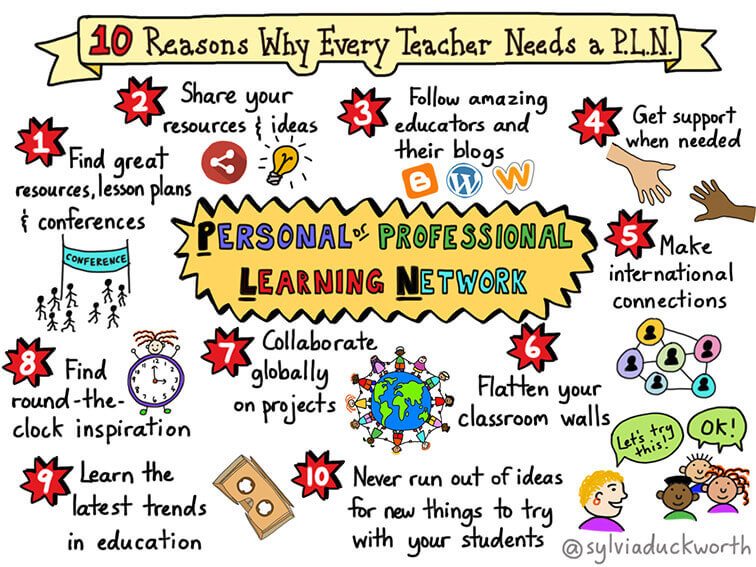
He shared the image below, which highlights the ways that teachers can benefit professionally from a PLN. What sticks out to me is that a PLN can help keep teachers up to date with new trends in education and help keep them inspired. Something that I have seen come through in my courses this past year is that in order to deliver engaging lessons to your students, you also need to be excited about the material. By engaging with my PLN, I anticipate exploring new avenues for my lessons that are exciting for me as well as my students.
What are the strengths and weaknesses of my PLN and the inclusion of AI?
As I discussed in one of my previous blog posts, I don’t think that my PLN is diverse enough in terms of perspectives. I have a lot of connections from the same general geographic area as me, which means that they have similar thoughts and ideas. Moving forward, I would like to work on diversifying my PLN by engaging with people from different backgrounds. One highlight of my PLN is that I was able to make lots of connections through a summer program that I attended in 2023. It was a month-long STEM and entrepreneurship program that invited students from all over Canada to participate in workshops and seminars on a variety of STEAM-related topics. Through this opportunity, I made many meaningful connections with other students from various provinces who all continued on different educational paths. As a result, I have the privilege to know many accomplished and talented individuals who have had different experiences from me and who can expose me to different worldviews.
Because my PLN is comprised of many connections from where I grew up, I don’t have as many connections with fellow educators as I would like. However, I do follow some educators on LinkedIn, and I have made many wonderful connections within my program. These connections are ultimately more relevant to my professional development, as they are the connections that can inspire me in terms of new material for lesson planning and instructional methods. Something that I admire so much about the teaching profession is that Educators are so open to sharing resources and ideas. The Educators that I encounter in my PLN, online and in person, have been so welcoming and eager to share their resources, which have been very helpful to me as I develop my teaching practice and collect materials.
I found the article by Estaiteyeh and Mindzak (2025) so interesting because I am also a preservice teacher in this new age of AI technologies. I enjoyed reading the article because I saw myself in the students, and it challenged my perspective by emphasizing the importance of embracing AI. The resounding conclusion of their research was that teachers must be trained on how to use AI responsibly and ethically so that they can use it in their practice, but also so that they can educate their students on responsible use of AI (pp.148-149). As a teacher education student, I want to work on embracing this perspective. I am generally nervous about AI use in education, but moving forward, I want to embrace this perspective. I think that, like the preservice teachers from the study, if I had more training on how to effectively use AI, I would feel more comfortable using it for educational purposes. That being said, I don’t think that my PLN includes AI in a particularly meaningful or useful way. To engage in professional development in the area of AI, I hope to explore Educators who use AI and have suggestions about how it may be useful. Additionally, I hope to look into courses that I could take to ensure that I know how to use AI responsibly as an Educator.
My thoughts on Prime Minister Carney’s new national artificial intelligence strategy.
A few days ago, Prime Minister Carney released a statement about his new national artificial intelligence strategy that aims to ensure equal access to AI technology for all Canadians. What interests me is their goal to establish a New National AI Literacy Initiative. They specify that this will involve “train[ing] more than 3,000 educators with AI learning kits in their classrooms”. This relates to my thoughts above about establishing more training for preservice teachers so that they can then use AI more effectively in their classrooms. As a preservice teacher, I hope that this initiative proves to be useful and that it can help teachers feel more confident about using AI to benefit their teaching practice.
— Sofia
Burton, S. (2014). Pros and cons of professional learning networks. Spencer Burton: Learning about Learning. https://www.spencerburton.ca/pros-and-cons-of-professional-learning-networks-plns/
Estaiteyeh, M., & Mindzak, M. (2025). Building AI literacy in pre-service teacher education in Canada: A case study of two cohorts. Journal of Teaching and Learning, 19(4), 135–154. https://doi.org/10.22329/jtl.v19i4.10041
Kumari, N., & Patra, B. C. (2026). AI and inclusive education: Enhancing equity, engagement and excellence. In K. M. Soni, N. Hasteer, A. Bhardwaj, R. Sindhwani, & J. P. Davim (Eds.), AI-Based Solutions for Inclusive Quality Education (pp. 27–44). CRC Press. https://www-taylorfrancis-com.ezproxy.library.uvic.ca/reader/read-online/ff028100-00c2-4e1a-b258-0cd361809479/book/pdf?context=ubx
Prime Minister of Canada. (2026, June 4). Prime Minister Carney launches AI for all: Canada’s new national artificial intelligence strategy. Government of Canada. https://www.pm.gc.ca/en/news/news-releases/2026/06/04/prime-minister-carney-launches-ai-all-canadas-new-national-artificial
Tusquellas, N., Palau, R., & Santiago, R. (2024). Analysis of the potential of artificial intelligence for professional development and talent management: A systematic literature review. International Journal of Information Management Data Insights, 4. https://doi.org/10.1016/j.jjimei.2024.100288

Hi Sofia! Nice post! I found your discussion about AI in education really interesting, especially your point about teachers needing more training about AI in the classroom. I am also hesitant about AI because I worry about students becoming too dependent on it. I liked how you emphasized that teachers need to learn how to use AI responsibly so that they can model those skills for their students as well, similar to media literacy.
Your experience in the STEM and entrepreneurship program sounded like a great example of how meaningful connections with people from different backgrounds can broaden our perspectives. I also connected with your reflection on wanting a more diverse PLN. I think it is easy to stay within familiar networks and perspectives, especially when many of our connections come from a similar background