Author: sofiah11 (Page 2 of 4)

PLNs & Education

What is the role of social media in education?

Social media can help teachers and students stay connected during periods of online learning or if a student is unable to come to school. It can also help teachers and students stay connected to the world around them and ensure that they are staying up to date with current issues and world events. This is so important for students if we want them to develop global citizenship. They need to learn how the world works, how to value differences in people, and work together to find solutions to big problems (UNESCO, 2026).

What are some problems with social media communications in education settings?

Social media includes many tools that can be useful for education, but it also comes with risks for students. The first issue that comes to mind for me is privacy for students online. Social media platforms may be helpful for teaching, but when they require students’ personal information, they become unsafe.

In the video below, Harry Dyer discusses how, with the increase in use of social media, there has also been less of a clear divide between the offline world and the online world (TEDx Talks, 6:46, 2016). While I agree that the online world brings in new ways of communicating, which can be beneficial for students, I also worry that students will gain less interest in their local environment and the physical things that exist in their classrooms and at home.

Another concern with social media communication and schools is that, along with newfound access to global perspectives, comes the possibility of cyberbullying and online harassment. Students can easily communicate with people they don’t know who are capable of causing mental, emotional, and physical harm (UNICEF, 2026). To ensure that students are using social media safely, educators should introduce conversations around how to use it and what to avoid.

What is the role of a PLN in a professional capacity?

In education, collaboration is a useful tool to ensure that you are providing current, effective, and engaging lessons for your students. Having a PLN in a professional capacity allows you to make new connections with fellow educators and peers, as well as gain new insights from non-educators. In his course EC&I 831, Alec Couros describes how he embedded the Open Movement: He explains that the open movement prioritizes sharing, transparency, accessibility, and interoperability (Couros, p.111, 2010). As educators, we can build an effective network that allows for collaboration through openness with our peers by prioritizing the same values as the Open Movement and developing a willingness to help colleagues.

Which social media platforms are beneficial in education?

A digital platform that I used during my elementary and high school education is the Google Suite. My classmates and I each had our own Google email linked to our school district, which allowed us to have access to Docs, Slides, Sheets, Classroom, and more. I really liked the Google Classroom system because it allowed students and teachers to communicate on one platform, all while creating projects in a consistent format. Microsoft Teams can also be useful for the same reasons: it allows you to communicate with everyone in your team, and you are able to conveniently share files and assignments.

When working with the vulnerable sector, how does social media fit into professionalism and regulations?

As a prospective teacher in BC, I have spent lots of time getting to know the Professional Standards for BC Educators, a document created by the BC Teachers’ Council that outlines the standards that all educators are held to to ensure the success and safety of students. As mentioned in the document (embedded below), educators must always act in the best interest of their students. It acknowledges that Educators are put in a position of trust and authority, adding that they must respect student privacy and that they cannot abuse or exploit students (BC Teachers’ Council, 2019). When using social media, teachers must keep in mind student privacy. It is not safe to post any personal information about a student or any pictures where they may be identifiable.

In addition, Standard 2 explains that educators must “act ethically and uphold the integrity, credibility, and reputation of the profession” (BC Teachers’ Council, p.4, 2019). Educators are held to a higher standard, meaning that they must act ethically on and off duty. On social media, this means understanding that anything you choose to put online can reflect on you as a teacher and on the profession.

— Sofia

BC Teachers’ Council. (2019). Professional standards for BC educators. https://www2.gov.bc.ca/assets/gov/education/kindergarten-to-grade-12/teach/teacher-regulation/standards-for-educators/edu_standards.pdf

Couros, A. (2010). Developing personal learning networks for open and social learning. In G. Veletsianos (Ed.), Emerging Technologies in Distance Education (pp. 109–128). AU Press. https://www.aupress.ca/app/uploads/120177_99Z_Veletsianos_2010-Emerging_Technologies_in_Distance_Education.pdf

TEDx Talks. (2016). Incorporating & accounting for Social Media in Education | Harry Dyer | TEDxNorwichED. In YouTube. https://www.youtube.com/watch?v=ZteEZbAtsNI

UNESCO. (2026). What you need to know about global citizenship education. Global Citizenship and Peace Education. https://www.unesco.org/en/global-citizenship-peace-education/need-know

Unicef. (2026). Cyberbullying: What is it and how to stop it. UNICEF, for Every Child. https://www.unicef.org/stories/how-to-stop-cyberbullying
Public PLNs: Balancing PLNs, Media Literacy, and Public Discourse

What is Media Literacy? Why is it important? Why is it dismissed? Open dialogues about media literacy and factual information can create conflict. Why does this happen? What is the benefit of having a PLN that values media literacy?

Media literacy is the ability to use media resources for learning and creation, as well as being able to analyze media to create compelling forms of communication (Trilling & Fadel, 2009). It is an important skill for global citizens to have as the use of technology increases and it becomes more of an essential part of education, professional settings, and life in general. It can be dismissed because technology is still evolving, and most life skills can generally be done without it. I think media literacy can also seem like an obvious skill that everybody has, when in reality, it can be difficult, and it requires thought and reflection.

Creating an open dialogue around media literacy and factual information is ultimately important because it creates awareness of the importance of media literacy; however, it can create conflict when in the context of confronting someone’s personal beliefs. Generally, people don’t like being told that something they put their belief and trust into is not real or being told that they should know better. Conversations around media literacy can involve the discussion of “fake news”, which can be polarizing in social media communities: it becomes a debate around “who gets to define ‘truth'”(p. 78, 2019).

A PLN that values media literacy would welcome critiques and constructive feedback while encouraging its members to communicate clearly and effectively. This leads to a more authentic form of communication and a sense of trust between you and your connections.

How do notable individuals use social media? What are the benefits of being in the public eye and having a PLN?

One of the benefits of being in the public eye and having a PLN is that you are able to advocate for causes that you are passionate about and reach a wider audience. Sophie Lui, a news anchor at Global BC, shared that as a professional in the public eye, she is able to provide support to her peers during incidents of misogyny and other unwarranted comments (Miller, 24:50, 2026). A downside of being in the public eye could be that, because you can be seen by a wider audience, you may receive rude or unwanted commentary. Notable individuals need to pay more attention to what they choose to put forward on social media and think about how it could be perceived.

What are the risks and benefits of engaging with a public audience in a media space? What are the risks for a public figure or person in a position of trust?

As mentioned above, a benefit of engaging with a public audience is that you can reach a wider audience and promote issues that are important to you. You are also able to engage with a more diverse group of people, which brings new perspectives, thoughts, and opinions. The risks for someone in a position of trust, like an educator, are that parents and employers are able to look at their online social presence and form opinions. As an educator, parents trust you to promote good values and ultimately, keep their children safe.

How to best address negative replies and critiques reflective of your personal values and your employer’s social media policy?

I think the best way to address negative replies is to acknowledge that not all commentary is useful and that not all comments dignify a response. The first step would be to discern if a negative reply has any constructive feedback that could be applied. If yes, there may be something to carry forward, but if not, it’s best left behind.

A content creator that I enjoy engaging with is Hank Green. He has a video (that I included below) about how he addresses negative comments and shares some of his reflections on the current culture around commenting on social media. Something he shared, which I like, is that it’s important to remember that when people leave negative comments, they are choosing to bring that negativity into their life, instead of choosing to approach something out of joy or fun (Green, 2024).

How would I curate my social media presence for a critical audience?

As a future educator, I know that my digital identity is important because it contributes to my credibility as someone who works with the vulnerable sector. With that in mind, I try to keep my social media presence respectful, in addition to thinking about what I would want to see on a prospective teacher’s social media presence.

Building community with online tools provided by the employer can be limiting. What are the perceived restrictions and benefits?

When I think of an online tool provided by an employer, my first thought goes to a platform like Slack or Microsoft Teams. These platforms are great because they allow you to communicate more easily with people within your organization. However, they create a stronger divide between work and your personal life, which can limit your motivation to make connections with colleagues. For example, if your only way of communication with a colleague is through Slack, when you are done with work for the day, you may not be thinking about how you can build a connection with said colleague through Slack.

— Sofia

Green, H. (2024). Why Celebrities Suck at Handling Criticism (Including Me). https://www.youtube.com/watch?v=vDwLre7P7UU

Hirst, M. (2019). The political economy of fake news. In Navigating Social Journalism. Routledge. https://www-taylorfrancis-com.ezproxy.library.uvic.ca/reader/read-online/3a03dd4e-15eb-450a-8965-951bf1919754/book/pdf?context=ubx

Miller, J. (2026). EDCI 338 – A01 Week 3.YouTube. https://www.youtube.com/watch?v=ovAAdXiHWYs

Trilling, B., & Fadel, C. (2009). Digital literacy skills. In 21st Century Skills: Learning for Life in Our Times. Jossey-Bass. https://learning-oreilly-com.ezproxy.library.uvic.ca/library/view/21st-century-skills/9780470475386/fade_9780470475386_oeb_c04_r1.html#h1

Personal Learning Networks, Diversity, and Inclusion

My Personal Learning Network (PLN) and Social Media Use

Although I use social media to maintain connections, I would consider the majority of my connections to be from in-person interactions and relationships.I have lived in the same house, in the same city, for my whole life, so I have come to know my community very well. I went to a small school, so I know my former classmates and their families well. Additionally, I work at a nearby community centre where I am able to interact with new members of the community and young families. Because where I live tends to have a similar type of demographic, I lack some diversity in this part of my PLN.

The main social medias that I use to maintain my PLN are Instagram and LinkedIn. I use Instagram to consume content that I enjoy, but also to keep up with friends and acquaintances. I use LinkedIn for connections related to my chosen field, Education. A few years ago, I had the opportunity to participate in a month-long summer program where I met other students my age from across the country. I use both LinkedIn and Instagram to keep up with those connections. Through my online connections, I have access to a variety of perspectives that allow me to learn new things and consider new avenues for my professional development.

How does social media engage communications? How does social media challenge communications?

Social media engages us because it allows us to talk to people with similar points of view to us. People who may have a hard time finding peers and companions can find a safe place on a digital platform with people who understand their perspectives. Social media and digital platforms can also increase communication. In a professional setting, this means that a team can continue to communicate during extenuating circumstances, like a coworker needing to be away or not feeling well. In the context of teaching and education, digital platforms can help students by keeping them connected to class activities and new learning.

Social media also challenges communication because it can increase miscommunication between friends and acquaintances. It can be harder to understand someone’s intentions when they aren’t in the same room as you. In a professional setting, it is important to be on the same page and to communicate clearly. That can be difficult if you isolate a person’s words from their tone and facial expressions. Similarly, face-to-face interactions can be helpful to a student’s learning and social development.

Is it inclusive?

In the introduction to the book One Without the Other: Stories of Unity Through Diversity and Inclusion, Shelley Moore (2016) shares the story of how a student challenged her model of inclusion. Inclusion is not only when everybody is welcomed and respected, but it is also when we disregard the notion of an “other” (p. 8). While social media can be a place where all individuals can share their perspectives and ideas, it can never truly be inclusive until platforms are available to everyone, regardless of structural barriers. The Department of Economic and Social Affairs (2025) explains that we must aim for equitable inclusion where everyone has “the same opportunities and that marginalized communities are not left behind.” As long as there are people in the world who do not have access to the same resources, social media or any PLN cannot be truly inclusive.

In their chapter “A New Vision for Public Media“, Clark and Aufderheide(2011) discuss how public media and democratic governance are mutually reinforcing(p. 61). Again, mentioning the idea that public media should be equally accessible to all members of a community or nation. In order for public media to support democratic governance, it must also support the fundamental right of equal access. In the context of Education, any digital or in-person learning network must be accessible to all students in order to provide a truly inclusive education.

Policies of employers and social media communication expectations

A person’s digital identity and social media communications can follow them into personal and professional interactions. Therefore, it is important to consider how you choose to communicate with friends and acquaintances. Unlike phone calls, messages on social media platforms can be kept and archived. Meaning that anything you say on a digital platform can be found. With that in mind, it’s important to always be respectful when communicating with others. As a future educator, I always think about how what I choose to present on my profiles and in my networks could potentially get back to an employer or a student’s parent: I want my future students and their parents to respect and trust me as an educator.

What are the benefits of a diverse and inclusive PLN in social media?

The benefit of a diverse and inclusive PLN is that you can gain new perspectives and ideas from your connections. Additionally, an inclusive PLN would welcome these ideas, which creates a safe space to share them. When your connections and acquaintances respect and welcome your thoughts, it also creates an atmosphere of growth and curiosity, which can greatly benefit your learning.

— Sofia

Clark, J., & Aufderheide, P. (2011). A new vision for public media. In S. C. Jansen, J. Pooley, & L. Taub-Pervizpour (Eds.), Media and Social Justice (pp. 55–67). Palgrave Macmillan. https://link.springer.com/chapter/10.1057/9780230119796_5#citeas

Department of Economic and Social Affairs. (2025). Digital Inclusion. United Nations. https://social.desa.un.org/issues/poverty-eradication/digital-inclusion

Moore, S. (2016). Introduction. In One without the Other: Stories of Unity through Diversity and Inclusion. Portage & Main Press. https://ebookcentral.proquest.com/lib/uvic/reader.action?docID=4832579&ppg=8&c=RVBVQg

Visitor and Resident Maps

What is a visitor and resident map?

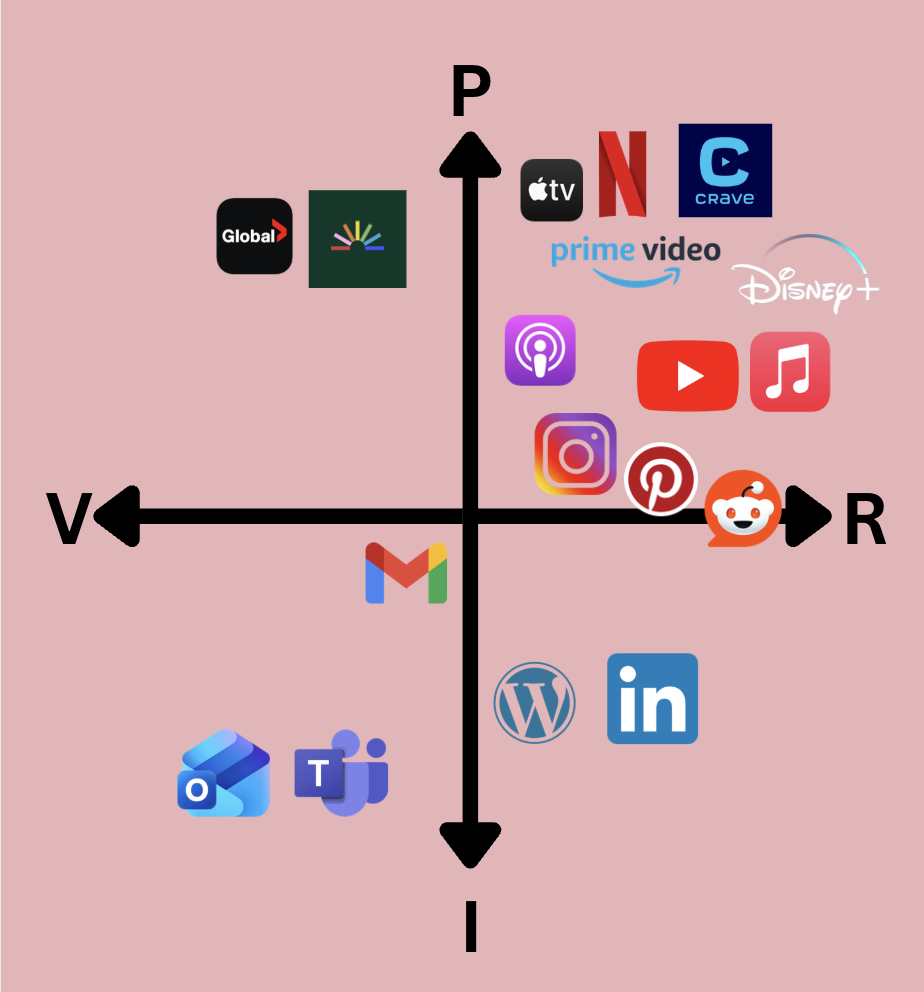
White and Le Cornu (2017) describe “visitor” and “resident” as ways to visualize the usage of online platforms. A visitor would be used to describe someone who only uses a certain platform for a specific reason, or to look for a certain tool. A resident would be someone who inhabits a digital platform, using it to create relationships and to converse with others, leaving traces of engagement.

Below is my own visitor and resident map!

The V and R on the horizontal axis refer to the spectrum of Visitor and Resident, and the vertical axis represents Personal vs. Institutional. Visual created by Sofia Huster on Canva.

What digital platforms do I use for personal reasons? For professional reasons? For both?

The majority of digital platforms I use are in resident mode and for personal reasons. I use some platforms more than others, but overall, I tend to inhabit fewer spaces rather than visit many. The platforms that I engage with in resident mode are also the ones that I use for personal reasons, like streaming platforms and social medias like Instagram. The platforms that I engage with in visitor mode are more likely to be ones that I use for professional/institutional reasons. One of the platforms that I use for both personal and professional reasons is Reddit. I enjoy exploring the platform to hear others’ thoughts on my favourite books, movies, and TV shows, but I also sometimes seek information about topics relating to school and professional development.

Final Thoughts

While I don’t have a vast professional network or professional digital identity, I think that it shows that I am more selective about which digital platforms I use. I don’t like having to keep track of several accounts from different online spaces, so I try to limit how many things I sign up for. Hopefully, anyone assessing my digital identity would see that I seek out digital platforms that enhance my digital presence in meaningful ways.

— Sofia

White, D. S., & Le Cornu, A. (2017). Using “visitors and residents” to visualize digital practices. First Monday, 8(7). https://firstmonday.org/ojs/index.php/fm/article/view/7802/6515

Digital Identity and Networked Publics

What is a Digital Identity?

Digital Identity can be summarized into the persona that you present on social media services and what you consume. It makes up your footprint on the web, which is something that peers, coworkers, and supervisors can search for (University of Derby, 2016, 0:25). As a future educator, this is something that I have had to keep in mind as I grow my online presence and sign up for more social media accounts. If not for professional reasons, your digital identity is important because it gives a snapshot of who you are, which anyone in your social world can see.

How do digital identities converge in networked publics? What are the impacts and/or benefits?

As previously mentioned, our digital identities are made up of all the various accounts and mentions from different networked publics. That can be good because all information can be accumulated together to create one digital identity that follows you as you explore the internet. On the other hand, it creates a privacy concern for users. Social media spaces take your information and what you consume to create targeted posts and ads that follow you across different services. They may also take your information and sell it to make a profit and keep their service free.

What does it mean to network using social media?

Networking is an attitude towards learning that needs to be cultivated, not something that can be visited occasionally at surface level. It is also intertwined with lifelong learning. Networking refers to the cultivation and creation of connections related to a person’s learning needs. On social media, that could be done by introducing yourself online or reaching out to people who may be useful connections. Rajagopal and colleagues(2012) describe three important tasks that build the basis of all connections within a network: building connections, maintaining connections, and activating connections. The second step, maintaining connections, could be greatly supported by social media. One of the main reasons why someone may sign up for a social media site is to keep up with friends and acquaintances that they may not see often. In that case, social media could help them network with friends and colleagues.

How are we motivated to participate in networked publics? What are the risks & rewards of public communications?

Network publics motivate us in the way that they allow us into a community of other users who could potentially lure us into a mutually reinforced point of view (Spracklen, 2015). Networked publics allow us to find groups of people who share similar interests, hobbies, and ideas, which is nice for building community, but can be dangerous if those groups are the only networks we engage with. Spracklen explains that social media makes it easy to unfriend or block someone who has different views from you, therefore reducing your exposure to differing perspectives. It is important to engage with various points of view on the internet to ensure you can form an educated opinion on current events and social contexts around the world.

How do personal versus professional approaches to digital identity affect social media use?

Someone with a personal approach to digital identity may use social media in a more close-minded way. Their usage could seek out what they would like to see and block out what doesn’t please them. Someone with a professional approach to social media may seek to make more connections with people they encounter on networked publics. Additionally, they may choose to engage with content that would benefit their professional learning needs.

Final Thoughts

I have always thought about my digital footprint when using social media, but this week’s reading and videos helped me gain a new understanding of the impact of digital identity and personal learning networks. Something that I found particularly interesting was the press conference on the value of digital identity for the global economy and society (World Economic Forum, 2019). I had always considered digital identity to be a digital footprint as it relates to social media use, but the forum discussed how it could be used in economic and political ways. A few of the speakers discussed how digital identities could be implemented as identification for people who are in the process of moving between countries and who may not have a government-issued ID in the first place (12:41).

— Sofia

Rajagopal, K., Joosten–ten Brinke, D., Van Bruggen, J., & Sloep, P. B. (2012). Understanding personal learning networks: Their structure, content and the networking skills needed to optimally use them. First Monday, 17(1).

Spracklen, K. (2015). Identity-Making and Social Media. In Digital Leisure, the Internet and Popular Culture (pp. 94–112). Palgrave Macmillan. https://link.springer.com/chapter/10.1057/9781137405876_6#citeas

University of Derby. (2016). Eric Stroller – What is Digital Identity? On YouTube. https://www.youtube.com/watch?v=u0RryRbJza0&t=25s

World Economic Forum. (2019). Davos 2019 – press conference on the value of digital identity for the global economy and society. On YouTube. https://www.youtube.com/watch?v=1-V7lyxrOmw

My Introduction

Hello everyone! My name is Sofia, and I am going into my third year of a four-year Bachelor of Education at UVic. When I’m not in Victoria for school, I can usually be found at home in West Vancouver reading, crocheting, sewing, and creating other random physical media projects.

I took my first EdTech class in the fall, and I loved how it allowed me to create a space for reflection and curation of useful resources. I am really looking forward to continuing my growth in the area of EdTech this summer and discovering new ways to think about technology.

I have also just completed my first practicum in a Grade 6 classroom, so I am excited to absorb new learning in the hopes of making my teaching practice as inclusive, exciting, and meaningful as I can as I move forward with my next practicums and lesson-planning assignments.

As I previously mentioned, I love to read! One of my favourite authors is Jane Austen, but I love to read books of any genre. I also love sewing and crocheting. I have been sewing since I was around 10 years old, and crocheting for a few years. I love both because they allow me to create my own things from scratch and make things for the treasured people in my life.

As for music, I mainly listen to pop music by Taylor Swift, Olivia Rodrigo, Sabrina Carpenter, Harry Styles, and Conan Gray. I also love folk and alternative music, but don’t always know where to start, so let me know if you have any suggestions!

— Sofia 🎀

Reflections on the Ed Camp experience

This week our class had the opportunity to participate in an Ed Camp, a professional development opportunity where we discussed topics related to teaching and learning with our peers. Some of the topics we discussed were the use of AI in the classroom, how physical education and technology can work together in the classroom, and the role of nature-based education.

The group that I participated in was discussing the role of nature-based education, its benefits, and ideas for how it can be incorporated into the classroom.

One of the main things we discussed was that some schools have really good outdoor setups and others don’t which impacts a teacher’s ability to incorporate nature-based learning. If a school has outdoor spaces that facilitate that kind of learning it is very beneficial to students, but not all schools have that because of financial or environmental factors. Another piece that was shared is that some schools may have restrictions or guidelines about when a teacher can take their class outside.

We considered that nature-based learning could be great for accommodating the needs of different learners. Some students work best with hands-on activities and opportunities for exploration. Additionally, going outside for a lesson could be the change of scenery that your class needs for their focus and engagement. That being said, creating opportunities for nature-based learning would depend on the grade level and your class’s overall disposition. Outside time is great for learners of all ages, but an older grade might focus better during an outside lesson.

Finally, we discussed how exploration and hands-on discovery experiences are great for learning as long as they are paired with some more structured activities. For example, a nature-based lesson could be paired with a worksheet to reinforce learning or another kind of project to ensure that the learning sticks.

My inspiration to include nature-based learning in my future classroom largely comes from my own experiences in elementary school. The school that I attended, Pauline Johnson Elementary School in West Vancouver (School District 45), had lots of outdoor spaces such as a First Peoples’ healing circle, an outdoor classroom with a white board, and a small ampitheatre. The park was finsihed in 2017 and has been an amazing addition to the school and the community. As a student, I loved being able to go outside for our lessons and independent work time for our projects. To learn mroe about the park and its creation check out their website: PJ Outdoor Learning and Community Park

Overall, my experience of participating in our class’ Ed Camp was great! I enjoyed the opportunity to discuss topics related to teaching with my peers in a low-stress environment. It was interesting to see what we as a class could come up with and make connections about what is important to us as future educators.

— Sofia 🎀

Final Inquiry Post

For my final inquiry post, I’ve created a video to encapsulate my reflections on my inquiry project. The video, uploaded below, includes a summary of my project, a reflection on my process, and a reflection on the role of technology in my project.

Overall, I am really proud of my project! I had a great time exploring and experimenting with new materials and ideas. Although the project is done for now, I hope to add new pages over the next few years and post updates. Thank you for tagging along with my process and I hope it was helpful for anybody who is hoping to take on a similar project!

— Sofia 🎀

Written Video Script:

This semester, I started the process of making my own recipe book. Baking has always been an important part of my childhood and one of my biggest hobbies now. I had always wanted to have a nice, hand-crafted recipe book one day with all of my favourite recipes, but it always seemed daunting and intimidating to start. This free inquiry assignment was the perfect opportunity to dip my toe into journaling in a sense, and good motivation to start a project that I have been thinking about for a long time. In my first post, I set out my idea and goal for this project, which was to make a hand-crafted recipe book with a unique page for each of my favourite recipes. While I have not finished the project yet (because I still have many recipes I want to add), I am very proud of what I have accomplished.

My process started with making a cover page for my recipe book. I used a great website called Floss Cross to make a cross-stitch pattern and leaned on my previous cross-stitching experience to make something that I really liked and felt personal to me Next, I started my process of curating and finding materials for this project. I bought some materials that I didn’t end up using, and thrifted some old books that proved to be very useful to my project. I also used a lot of materials that I already had in my craft bin. Next, I made pages for 5 different recipes of mine: Chocolate Chip Oatmeal Cookies, Boesch Back, Lasagna, Blueberry Muffins, and Apple Crisp. I made an effort to try different things for every page and make each page its own. For each page, I wrote out the ingredients and instructions, made a title card, and added decorations that I drew.

This learning process allowed me to explore my creative abilities and combine lots of my interests. I have always loved making physical crafts using different materials and techniques. For this project, I cross-stitched, I collaged, I drew, and I did some printing. I think this process was very good practice for me to work steadily towards a goal. The problem I have when taking on new projects is that I have big visions of what I want them to look like, get very motivated and work on them all the time, then get disappointed when the finished product is not what I envisioned. My process for working on this project was to create one page of the recipe book per week, which allowed me to spend time on each page. If I had taken on too much with this project and tried to make pages for all my recipes very quickly, I do not think I would have loved my end product as much as I do. And even though I haven’t filled the book yet or added all my favourite recipes, I am excited to add to it over the next few years.

My main use of technology for this project was the inspiration. I love scrolling and browsing ideas on Pinterest, and I definitely got inspired by all the pins about journaling and recipe pages. I love using Pinterest for all my projects because I love seeing the variety of ideas for one project. Everyone who posts their pictures on there has so many different ways of approaching and executing project ideas, which inspires me to explore the ways that I can make something. Aside from inspiration, technology has helped me catalogue my memories. Each of the recipes that I have made for my book are special to me in a different way. Technology allowed me to create a space for my memories associated with the project but also for this new memory of making this project.

Reflections on Artificial Intelligence in Education

Last week, we had the pleasure of speaking with Cari Wilson, the Vice-Principal of Innovation and Technology at School District 45, West Vancouver. This felt extra special to me because I grew up in West Vancouver and attended SD45 schools for my entire K-12 education. I was very interested to learn more about the district on the Educator side, having looked at it from a student perspective for most of my life.

We started the session with an exercise called the 3 W’s. We were encouraged to share one “I wish”, one “I wonder” and one “I worry”. Some of my thoughts about Artificial Intelligence(AI) were that I wish we could teach young students how to use it responsibly, I wonder how AI will continue to grow, and I worry that the students’ use of AI will discourage creative thinking and learning through trial and error. To be honest, I have a lot of worries and reservations about the use of AI in schools and in general. I rarely (if not never) use AI in my daily life and for my schoolwork, so the idea of using AI in the classroom makes me nervous.

Students currently in primary grades are the first generation of children to grow up with AI, so we have the unique opportunity to teach them how to use it responsibly at a young age. One of my worries about AI is that it is a part of a technological takeover that is continuing to grow. However, I know that technologies will continue to be developed and improved upon and now is the opportunity to learn how to work with technology and grow with it.

Something I found especially interesting from Cari’s presentation was when she talked about how AI actually works, specifically generative AIs like Chat GPT and Language Learning Models. One thing that made me nervous about AI is that I didn’t know how it works; they felt like mysterious and supernatural presences in my life. After learning how they actually work, they seems less intimidating to me.

I’ve linked a video below that explains how generative AI programs work:

Next, Cari talked about some concerns around the use of AI in schools. One of the major ones being privacy. When using AI it is very important not to share personal information about students like their photos, their age, and their name. For example, if you are using an AI program to help generate comments for students’ report cards, be sure not to include their name or age. Generative AI programs train on large amounts of data, and the information that you share in yoru prompts can also be stored and used.

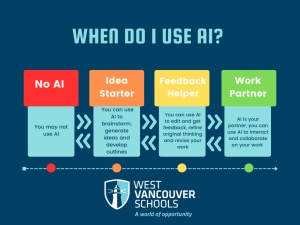
Another concern is regulating responsible use of AI and ensuring that students are adhering to academic integrity standards. This concern is more relevant for older grades when students work more independently from teachers. AI can be a great tool for brainstorming ideas and for project feedback, but it is important to be transparent about its use. One of Cari’s suggestions was to have zones for AI use. Red is for “no AI”, orange for “Idea Starter”, yellow for “Feedback helper” and Green for “Work Partner”. I really like this diea because it reminds me of the sel-regulation zones used in elementary classrooms. The zones would be used by a teacher to determine the time and place for the use of AI for assignments.

Zones for AI use, image taken from Chris Kennedy’s blog, The Culture of Yes

Some other concerns that stood out to me were hallucinations and deep fakes. Hallucination is a term for when an AI program gives an answer that is false. It is important for students to learn how to recognize false information and not to blindly trust AI. Deepfakes are a form of synthetic media that depict real of fictional people. They often represent people inauthentically and can aid the spread of misinformation. The concern for learning would be that students are not able to recognize this form of synthetic media and they would trust false information spread by these deepfakes.

Despite all these concerns about the use of AI in the classroom, AI tools can make a world of difference for students with learning differences. Differentiation is an important part of making lessons accessible for all students, and with AI tools, it is much easier and more effective. Some tools that Cari recommended for teachers are Chat GPT, Google Gemeni, Perplexity, Diffit for teachers, Magic School AI, Brisk AI for Teachers, and Notebook LLM.

Although the use of AI in classrooms makes me nervous, I acknowledge that if I become more comfortable with it now, I can help my students in the long run. After having the session with Cari, I feel more informed and ready to explore what these AI tools have to offer!

— Sofia 🎀

« Older posts Newer posts »

© 2026 Sofia's Blog

Theme by Anders NorenUp ↑