Last week, we had the pleasure of speaking with Cari Wilson, the Vice-Principal of Innovation and Technology at School District 45, West Vancouver. This felt extra special to me because I grew up in West Vancouver and attended SD45 schools for my entire K-12 education. I was very interested to learn more about the district on the Educator side, having looked at it from a student perspective for most of my life.
We started the session with an exercise called the 3 W’s. We were encouraged to share one “I wish”, one “I wonder” and one “I worry”. Some of my thoughts about Artificial Intelligence(AI) were that I wish we could teach young students how to use it responsibly, I wonder how AI will continue to grow, and I worry that the students’ use of AI will discourage creative thinking and learning through trial and error. To be honest, I have a lot of worries and reservations about the use of AI in schools and in general. I rarely (if not never) use AI in my daily life and for my schoolwork, so the idea of using AI in the classroom makes me nervous.
Students currently in primary grades are the first generation of children to grow up with AI, so we have the unique opportunity to teach them how to use it responsibly at a young age. One of my worries about AI is that it is a part of a technological takeover that is continuing to grow. However, I know that technologies will continue to be developed and improved upon and now is the opportunity to learn how to work with technology and grow with it.
Something I found especially interesting from Cari’s presentation was when she talked about how AI actually works, specifically generative AIs like Chat GPT and Language Learning Models. One thing that made me nervous about AI is that I didn’t know how it works; they felt like mysterious and supernatural presences in my life. After learning how they actually work, they seems less intimidating to me.
I’ve linked a video below that explains how generative AI programs work:
Next, Cari talked about some concerns around the use of AI in schools. One of the major ones being privacy. When using AI it is very important not to share personal information about students like their photos, their age, and their name. For example, if you are using an AI program to help generate comments for students’ report cards, be sure not to include their name or age. Generative AI programs train on large amounts of data, and the information that you share in yoru prompts can also be stored and used.
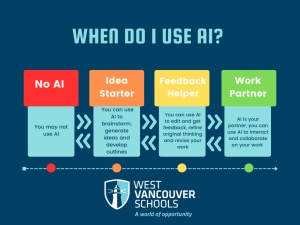
Another concern is regulating responsible use of AI and ensuring that students are adhering to academic integrity standards. This concern is more relevant for older grades when students work more independently from teachers. AI can be a great tool for brainstorming ideas and for project feedback, but it is important to be transparent about its use. One of Cari’s suggestions was to have zones for AI use. Red is for “no AI”, orange for “Idea Starter”, yellow for “Feedback helper” and Green for “Work Partner”. I really like this diea because it reminds me of the sel-regulation zones used in elementary classrooms. The zones would be used by a teacher to determine the time and place for the use of AI for assignments.
Some other concerns that stood out to me were hallucinations and deep fakes. Hallucination is a term for when an AI program gives an answer that is false. It is important for students to learn how to recognize false information and not to blindly trust AI. Deepfakes are a form of synthetic media that depict real of fictional people. They often represent people inauthentically and can aid the spread of misinformation. The concern for learning would be that students are not able to recognize this form of synthetic media and they would trust false information spread by these deepfakes.
Despite all these concerns about the use of AI in the classroom, AI tools can make a world of difference for students with learning differences. Differentiation is an important part of making lessons accessible for all students, and with AI tools, it is much easier and more effective. Some tools that Cari recommended for teachers are Chat GPT, Google Gemeni, Perplexity, Diffit for teachers, Magic School AI, Brisk AI for Teachers, and Notebook LLM.
Although the use of AI in classrooms makes me nervous, I acknowledge that if I become more comfortable with it now, I can help my students in the long run. After having the session with Cari, I feel more informed and ready to explore what these AI tools have to offer!
— Sofia 🎀